
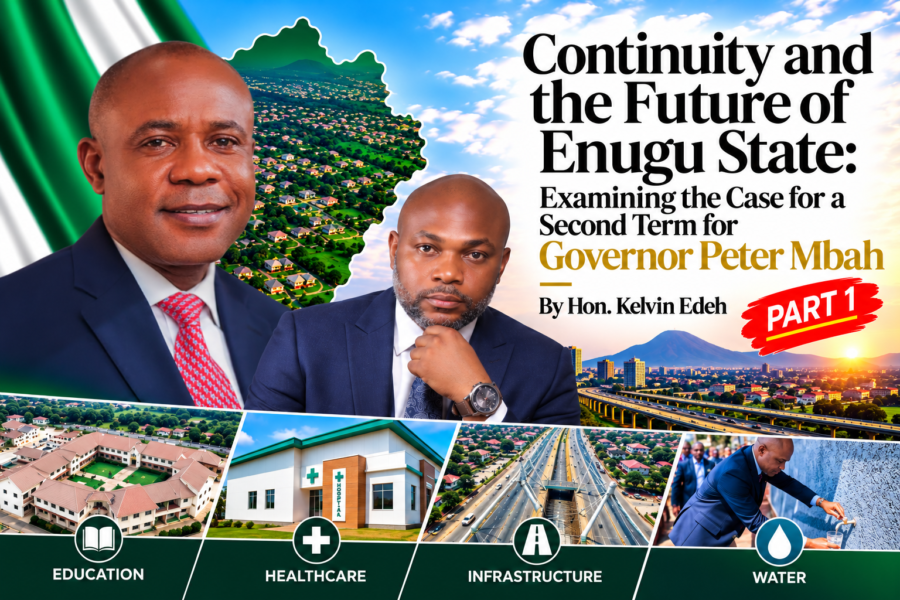
When the Numbers Begin to Tell the Story
Politics is about promises. Governance is about results.
As Enugu State looks ahead to another gubernatorial election, the important question should not simply be who is the most popular?
It should be:
Is Enugu moving in the right direction, and should the current development agenda be given more time to mature?
Governor Peter Mbah came into office in 2023 with an ambitious promise to reposition Enugu through infrastructure, education, healthcare, economic development and improved revenue generation.
Two areas provide an interesting starting point: public investment and internally generated revenue (IGR).
1. A Government That Has Shifted the Scale of Public Investment
One of the easiest ways to understand a government’s priorities is to look at its budget.
In 2024, Enugu’s budget was about ₦521.6 billion, with approximately ₦414.3 billion (79%) allocated to capital expenditure.
In 2025, the budget rose to approximately ₦971.1 billion, with ₦837.9 billion (86%) earmarked for capital projects.
By 2026, the proposed budget had reached approximately ₦1.617 trillion, with about ₦1.296 trillion (80%) allocated to capital expenditure.
In simple terms:
2024: ₦521.6bn budget
2025: ₦971.1bn
2026: ₦1.617tn
That is a dramatic increase in the scale of government investment.
But a large budget alone does not equal good governance.
The real question is:
Are the funds actually being converted into projects and services that improve people’s lives?
According to the state’s reported 2025 budget performance, approximately ₦667.2 billion was spent on capital projects, representing about 81% of the revised capital budget.
That deserves attention.
The bigger picture is that Enugu is spending heavily on infrastructure that can potentially support economic growth, roads, schools, healthcare, water and other public facilities.
And this leads to an important point:
Infrastructure is not just about buildings and roads. It is about creating the environment in which people can work, trade, study, invest and prosper.
2. The IGR Story: From Dependence to Greater Fiscal Ambition
There is another number that deserves even more attention: Internally Generated Revenue.
For years, Nigerian states have depended heavily on federal allocations.
But a state that wants to develop sustainably must increasingly be able to generate resources from within its own economy.
Enugu’s IGR figures show a remarkable change.
2023 — ₦37.4 billion
2024 — ₦180.5 billion
2025 — ₦406.77 billion
According to the National Bureau of Statistics, Enugu generated approximately ₦180.5 billion in IGR in 2024, making it the highest IGR-generating state in the South-East and fifth nationally.
The reported 2025 figure of ₦406.77 billion represents more than double the 2024 figure.
These are significant numbers.
But there is something even more interesting.
The increase is not simply about taxation.
According to reported 2025 figures, approximately ₦51.5 billion came from tax revenue, while about ₦355.2 billion came from non-tax revenue.
This points to a broader effort to improve revenue collection and unlock value from government assets and other revenue sources.
Why Does IGR Matter?
Imagine Enugu generating more of its own money instead of depending almost entirely on Abuja.
It means greater capacity to:
- build infrastructure;
- improve healthcare;
- invest in education;
- maintain roads;
- provide water;
- support economic development; and
- respond to emergencies.
But there is an important condition:
More revenue must ultimately translate into better lives for the people.
Revenue generation should never become an end in itself.
The people of Enugu must be able to see where the money is going.
So, Why Does Continuity Matter?
This is where the second-term conversation becomes important.
The Mbah administration has embarked on projects and reforms that cannot produce their full benefits overnight.
A road can be completed today, but the businesses it attracts may emerge over the next five or ten years.
A school can be built today, but the children educated there may contribute to Enugu’s economy decades from now.
A healthcare center can be commissioned today, but its real success should ultimately be measured by better health outcomes.
And a revenue system can be reformed today, but building a sustainable fiscal system takes time.
Development has a gestation period.
That is why continuity deserves consideration.
But continuity should never mean blind loyalty.
It should mean:
Complete what has been started.
Improve what is not working.
Protect the investments already made.
Demand accountability for every naira spent.
And ensure that development reaches ordinary citizens.
The Real Question
The argument for Governor Peter Mbah’s second term should therefore not simply be:
“He has done enough.”
Rather, it should be:
“Has the administration established a direction that deserves to be consolidated, improved and completed?”
That is a much more important question.
Enugu has increased its budget significantly.
Its reported IGR has grown dramatically.
Capital investment has become a major priority.
The next challenge is ensuring that these numbers translate into jobs, businesses, better services and a higher quality of life for the people.
That is the standard by which the administration should ultimately be judged.
And that is why the conversation about continuity deserves to continue.
Coming in Part 2
Building the New Enugu: Roads, Infrastructure, Water and Economic Growth
In Part 2, we will examine the infrastructure projects underway across Enugu and ask:
Are these simply government projects or are they laying the foundation for a new Enugu economy?
Continuity. Consolidation. Completion.