
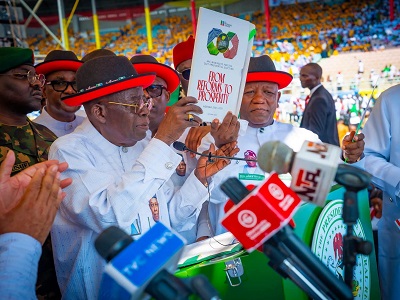
Manifesto Sets Targets of 6% Annual Economic Growth, 78,000 Additional Military and Police Personnel, 200,000 Affordable Homes and Expanded Job Opportunities by 2031.
Enugu Media Village (EMV), the Most Updated Online News Platform — November 12, 2026.
THE ALL PROGRESSIVE Congress (APC) has unveiled its policy manifesto for the 2027 presidential election, outlining an ambitious second-term development agenda for President Bola Ahmed Tinubu, with emphasis on economic growth, national security, affordable housing, job creation and improved living standards.
The manifesto, which sets out the party’s proposed priorities for 2027 to 2031, seeks to consolidate the economic and structural reforms introduced by the Tinubu administration since assuming office in May 2023.
However, its unveiling comes amid persistent concerns over the cost of living, with many Nigerian households still grappling with the effects of higher prices, reduced purchasing power and the wider economic adjustments associated with the removal of petrol subsidy and foreign exchange reforms.
At the manifesto presentation on November 10, senior government officials and APC representatives defended the administration’s reform programme while acknowledging that many Nigerians were yet to experience its anticipated benefits in their everyday lives. President Tinubu was reportedly absent from the launch event.
FOUR PILLARS OF THE APC MANIFESTO
The party’s proposed programme is organised around four broad pillars: national security; improved quality of life and affordable living; energy, infrastructure and economic growth; and effective and accountable governance.
Under its economic agenda, the APC is targeting annual economic growth of at least six per cent by 2031. The manifesto also proposes creating one million export-linked jobs for young Nigerians, establishing at least one major industrial hub in each of the six geopolitical zones and expanding access to affordable credit.
The party further intends to strengthen non-oil exports, manufacturing, agriculture and investment as part of its strategy to diversify the economy and create employment opportunities.
SECURITY: 78,000 ADDITIONAL PERSONNEL
On national security, the manifesto proposes recruiting and training 28,000 additional military personnel and 50,000 police officers, bringing the combined recruitment target to 78,000.
The plan also includes strengthening military formations, expanding intelligence gathering, improving border surveillance and deploying modern technology to combat terrorism, banditry, kidnapping and organised crime.
The APC equally proposes improvements in police response systems, body-camera deployment, digital policing and community-based security arrangements.
200,000 AFFORDABLE HOMES AND LOWER LIVING COSTS
Housing is another major component of the proposed agenda. The party has pledged to facilitate the construction of 200,000 affordable homes for Nigerian workers by 2031 through the proposed Tinubu Mass Social Housing Scheme, mortgage financing and partnerships with licensed private developers.
The manifesto also outlines plans to address inflation and food prices, expand domestic agricultural production, improve food storage and processing, and reduce transportation costs through infrastructure development.
These proposals are intended to improve household welfare and make essential goods and services more accessible to Nigerians.
EDUCATION, HEALTHCARE AND ELECTRICITY
In the social sector, the APC has proposed halving the number of out-of-school children by 2031, recruiting an additional 20,000 teachers and expanding digital literacy programmes to reach 30 million Nigerians.
The healthcare agenda includes increasing health insurance coverage to 40 per cent of the population and ensuring that at least 90 per cent of primary healthcare centres are functional.
For the power sector, the manifesto targets scaling available electricity generation towards 10,000 megawatts, extending metering coverage and strengthening transmission and distribution infrastructure.
GOVERNANCE AND PUBLIC ACCOUNTABILITY
The party has also pledged to introduce measurable performance targets for government commitments, publish progress reports and strengthen transparency in public service delivery.
The proposed accountability framework is expected to identify responsible officials, implementation timelines and measurable indicators for assessing the delivery of manifesto promises.
The APC says the next phase of its agenda will focus on translating the gains of economic reforms into tangible improvements in employment, household incomes, infrastructure and access to public services.
COST OF LIVING REMAINS A CENTRAL TEST
Despite the scale of the proposed commitments, the manifesto faces the important challenge of convincing Nigerians that economic reforms will translate into meaningful improvements in their daily lives.
The pressure on household budgets, food affordability, transportation costs, employment opportunities and access to reliable electricity remain important issues in the national conversation ahead of the 2027 general elections.
The APC has presented its manifesto as a framework for moving from economic stabilisation towards broader prosperity. Ultimately, the implementation of its targets, the resources committed to them and the measurable impact on ordinary Nigerians will be central to assessing the proposed second-term agenda.
Enugu Media Village (EMV) — Informing Enugu, Connecting the World.