
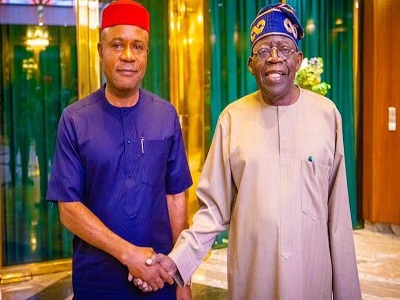
Dr. Collins Ogbu Makes Case for Political Alignment, Continuity and Greater South-East Participation in National Governance.
Enugu Media Village (EMV), the Most Updated Online News Platform — Thursday, November 12, 2026.
AS NIGERIA APPROACHES the 2027 general elections, political alignment, regional inclusion and the future of the South-East have become critical issues in determining the region’s place in the country’s political and economic landscape.
In this opinion article, Dr. Collins Ogbu, Esq., makes a compelling case for sustained political engagement with the ruling All Progressives Congress (APC), arguing that the South-East stands to gain more through strategic participation in national governance than through political isolation.
According to Ogbu, between 1999 and 2023, the South-East largely maintained its political allegiance to the Peoples Democratic Party (PDP), committing its votes, loyalty and electoral strength to the party. However, he argues that the region’s political loyalty did not translate into commensurate representation, strategic appointments and infrastructural development.
He maintains that the historical experience should inform the political decisions Ndi Igbo make ahead of the 2027 elections, stressing that the issue should transcend party affiliation and focus on the region’s long-term political and economic destiny.
TINUBU’S APPROACH TO THE SOUTH-EAST
Ogbu argues that President Bola Ahmed Tinubu has demonstrated a willingness to engage the South-East despite the region’s limited electoral support for him during the 2023 presidential election.
He describes the President’s approach as an example of statesmanship, noting that the Federal Government’s responsibility to citizens should not be determined solely by their voting preferences.
According to him, Tinubu’s decision to pursue national inclusion rather than political retaliation presents an opportunity for the South-East to strengthen its relationship with the Federal Government.
He believes that greater electoral support for the President in 2027 could further consolidate the region’s participation in national decision-making and create additional opportunities for development.
STRATEGIC MILITARY APPOINTMENTS AND NATIONAL INCLUSION
The article also highlights what Ogbu describes as significant representation of the South-East in Nigeria’s military leadership under the Tinubu administration.
He references the appointment of Vice Admiral Emmanuel Ikechukwu Ogalla, from Enugu State, as Chief of Naval Staff and the subsequent appointment of Air Vice Marshal Sunday Kelvin Aneke, also from Enugu State, as Chief of Air Staff.
Ogbu presents these appointments as important examples of the region’s participation in the country’s national security architecture, arguing that strategic representation in such institutions strengthens the sense of belonging and national inclusion among the Igbo people.
SEDC: A NEW DEVELOPMENT OPPORTUNITY FOR THE SOUTH-EAST
Another major achievement highlighted in the article is the establishment of the South-East Development Commission (SEDC), which President Tinubu assented to in 2024.
Ogbu describes the commission as a significant institutional framework for addressing the developmental challenges confronting the South-East.
He argues that the commission provides the region with a dedicated platform to pursue reconstruction, infrastructure renewal, economic expansion and regional development.
According to him, the SEDC represents an opportunity to advance the long-standing aspirations of the people for a comprehensive regional development programme, comparable to development interventions in other geopolitical zones.
ENGR. DAVE UMAHI AND FEDERAL INFRASTRUCTURE DEVELOPMENT
The author also draws attention to the appointment of Engr. Dave Umahi as Minister of Works, describing it as an important development for the South-East.
He identifies several strategic federal road projects, including the Enugu–Port Harcourt Expressway, Enugu–Onitsha Expressway, Second Niger Bridge access roads, Enugu–Abakaliki corridor, Owerri–Umuahia route and Aba–Ikot Ekpene corridor.
Ogbu argues that sustained investment in these infrastructure projects could improve transportation, strengthen commercial activities and enhance the region’s economic competitiveness.
He maintains that infrastructure development remains one of the most important measures through which the benefits of political participation should be assessed.
MBAH’S APC ALIGNMENT AND ENUGU’S DEVELOPMENT TRAJECTORY
Turning to Enugu State, Ogbu identifies Governor Peter Ndubuisi Mbah’s decision to align the state politically with the Federal Government through the APC as a strategic move with potential developmental benefits.
He argues that the relationship between the state and the Federal Government has created an opportunity for closer collaboration in pursuing infrastructure, education, healthcare, aviation and technology-driven development.
Among the major projects and initiatives highlighted in the article are the Smart Green Schools programme, Enugu Talent City, the proposed AI Institute, Enugu Air, the International Conference Centre, the 300-bed Enugu International Hospital and renewed efforts to improve water supply across Enugu metropolis.
The author particularly highlights the Smart Green Schools initiative, describing the programme’s planned coverage across the state’s electoral wards as an important investment in the future of education and human capital development.
He maintains that Governor Mbah’s development agenda, when supported by effective collaboration with the Federal Government, could accelerate Enugu’s transformation into a competitive economic destination.
ECONOMIC INTEGRATION AND THE FUTURE OF THE IGBO ECONOMY
Ogbu further argues that the South-East must position itself strategically within Nigeria’s emerging economic framework.
He references the Federal Government’s ambition to build a trillion-dollar economy, arguing that the South-East should be an active participant in that vision rather than remain politically disconnected from national economic decisions.
He identifies the South-East Development Commission, coastal road infrastructure, railway revitalisation, industrial development and the region’s natural resources as potential drivers of economic growth.
He also points to the commercial and industrial importance of Onitsha, Nnewi, Aba and Ogbete, stressing that improved infrastructure, reliable power supply and efficient transportation networks would strengthen the competitiveness of businesses across the region.
According to him, the South-East possesses the entrepreneurial capacity, human resources and industrial potential to reclaim its position as one of Africa’s leading commercial and manufacturing centres.
WHY POLITICAL ISOLATION MAY NOT SERVE NDI IGBO
Addressing the political implications of the 2027 elections, Ogbu cautions against what he describes as the limitations of political isolation.
He argues that sustained political engagement, strategic alliances and constructive participation in national governance are essential for any region seeking greater influence in a federal system.
He maintains that the South-East should approach the next general elections with a long-term political strategy, rather than allow historical grievances and partisan sentiments to determine its future.
The author further suggests that building stronger political relationships with other regions could improve the South-East’s prospects of securing greater national representation, including its long-term aspiration to produce Nigeria’s President.
He argues that the region’s political future should be built through strategic alliances, sustained engagement and a clear understanding of the country’s political dynamics.
2027: A DECISION ABOUT THE FUTURE
In his concluding argument, Ogbu urges Ndi Igbo to consider the developmental and political implications of their electoral choices in 2027.
He acknowledges that the APC, like every political party, has areas requiring improvement, but insists that the South-East should consolidate the opportunities he believes have emerged under the Tinubu and Mbah administrations.
He calls on voters across the region to support President Bola Ahmed Tinubu’s re-election bid, Governor Peter Mbah’s second-term ambition and APC candidates seeking elective offices at the National Assembly and State Houses of Assembly.
According to him, such support would strengthen the region’s political participation, improve its bargaining position and create opportunities for greater involvement in national development.
Ogbu concludes that the South-East must prioritise strategic engagement, continuity and long-term planning in pursuing its political and economic aspirations.
His message to Ndi Igbo is clear:
“Let 2027 be the year Ndi Igbo choose continuity over chaos, stability over sentiment, and the future over grudges. Let us not walk out of the room where Nigeria’s future is being decided. Let us stay, build and take our rightful place.”
Ndi Igbo, the time is now. Tomorrow is here.
About the Author: Dr. Collins Ogbu, Esq.
Enugu Media Village (EMV) — Informing Enugu, Connecting the World. Promoting Accountability, Public Participation, Transparency and Good Governance.