
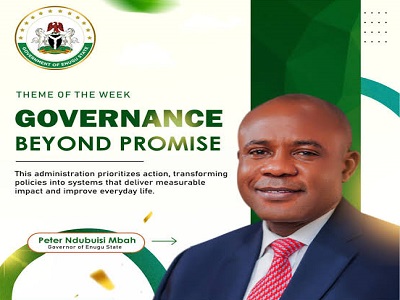
How Enugu State’s Development Agenda Is Taking Shape Through Roads, Education, Healthcare and Strategic Investments.
Enugu Media Village (EMV), the Most Updated Online News Platform— October 17, 2026.
WHEN Dr. Peter Ndubuisi Mbah assumed office as Governor of Enugu State in May 2023, he presented an ambitious vision of transforming the state into a leading destination for investment, business, tourism and improved living standards. More than three years into his administration, the central question is how far that vision has translated into projects, public services and measurable development outcomes.
The administration’s development agenda, anchored on the philosophy of “Tomorrow Is Here,” places emphasis on infrastructure, education, healthcare, security, agriculture, transportation and economic expansion.
Recent project updates, government records and reports from visiting professional bodies point to significant activity across several sectors. However, the full measure of success will ultimately depend not only on projects announced or constructed, but also on their completion, functionality, accessibility, maintenance and lasting impact on residents.
From Development Promises to Visible Infrastructure
Infrastructure remains one of the most visible pillars of the Mbah administration.
In an October 5 update, the Enugu State Ministry of Works and Infrastructure reported that the governor had inspected major projects, including the Owo–Ikem dual carriageway, the Amaechi-Idodo–Amagunze Road, the New Enugu City and the Enugu International Hospital.
According to the ministry, work on the 14.3-kilometre Amaechi-Idodo–Amagunze Road had reached the stage where asphalt wearing courses and road markings were completed, with formal commissioning still awaited at the time of the report.
At the New Enugu City, the primary road network was reported completed, while work on secondary and tertiary roads continued, with the remaining road infrastructure scheduled for completion by December 2026.
The ministry also reported substantial progress at the Enugu International Hospital, including completed installations and continuing external finishing works. These developments reflect the administration’s attempt to expand the state’s infrastructure base and improve access to essential services.
Beyond these projects, the government’s project monitoring platform provides a public-facing record of capital projects across the state’s 17 local government areas. Its published figures list 341 tracked projects, comprising 111 delivered projects and 230 ongoing projects. These figures offer a useful snapshot of the government’s project portfolio, although each project’s completion status and practical impact should be assessed individually.
For residents, the most important test is whether these investments reduce travel time, improve road safety, connect farming communities to markets, attract businesses and make everyday life more productive.
Education: Investing in the Next Generation
Education occupies a central position in the administration’s development strategy.
On October 7, 2026, Governor Mbah unveiled the Enugu State Education Policy at the 2026 Enugu Education Summit. The policy is intended to guide reforms over the next six to ten years, covering learning standards, teacher development, digital literacy, experiential learning and partnerships.
The state government reports that it has invested 33 per cent of its annual budget in education for three consecutive years and undertaken the development of more than 260 Smart Green Schools across the state’s political wards. It has also reported the construction of over 7,000 classrooms and initiatives to recruit and train teachers.
The policy’s long-term significance will depend on how effectively these investments translate into better learning outcomes, improved literacy and numeracy, stronger science and technology education, and greater opportunities for young people.
Modern school buildings are important, but qualified teachers, reliable electricity, learning materials, inclusive education and regular assessments are equally essential.
If the state can sustain these investments and demonstrate measurable improvements in student performance, education could become one of the strongest foundations of its economic transformation agenda.
Healthcare: Expanding Capacity and Access
Healthcare infrastructure is another important part of the administration’s programme.
The state government has listed 260 Type-2 Primary Healthcare Centres among its reported milestones. It has also highlighted the development of the Enugu International Hospital and ongoing work to upgrade existing health facilities, including Parklane Hospital.
These investments are intended to strengthen healthcare delivery, improve access to services and expand the state’s capacity to provide more specialised medical care.
However, the value of healthcare infrastructure cannot be judged by buildings alone. Functioning diagnostic equipment, adequate staffing, affordable treatment, essential medicines, emergency services and consistent maintenance are critical to ensuring that facilities deliver meaningful benefits.
For rural and underserved communities, accessible primary healthcare remains particularly important. The next phase of assessment should therefore examine whether residents can obtain timely, affordable and quality care close to where they live.
Transportation and Aviation: Connecting Enugu to Wider Markets
Transportation is another area in which the administration is pursuing a broader development vision.
The introduction of Enugu Air and the development of modern transport terminals are intended to improve connectivity, strengthen commercial activity and support tourism. The state government has also invested in compressed natural gas (CNG) buses as part of efforts to modernise public transportation.
In September 2026, the government announced the commencement of Enugu Air’s maiden international flight to Douala, Cameroon, marking a significant step in its ambition to position Enugu as a regional aviation and business hub.
The long-term benefits of these initiatives will depend on route sustainability, passenger demand, affordability, operational efficiency and the extent to which improved connectivity attracts new businesses and visitors.
For traders, entrepreneurs, investors and tourism operators, a reliable transportation network can reduce logistical barriers and create opportunities for market expansion.
Security and Technology: Building Confidence for Investment
Security remains a fundamental requirement for economic development. Businesses need a stable environment in which to operate, while residents require safe communities, roads and public spaces.
The Mbah administration has promoted a technology-driven security framework that includes surveillance infrastructure, a Command and Control Centre and coordinated responses to security incidents.
The government says these investments have strengthened its security architecture. Independent, transparent data on crime trends, response times and public safety outcomes would further help residents evaluate the scale and sustainability of the reported improvements.
The proposed integration of smart technologies into the New Enugu City also reflects an ambition to combine urban infrastructure with digital connectivity, traffic management and surveillance.
However, technology must be accompanied by trained personnel, dependable maintenance, privacy safeguards and effective emergency-response systems to deliver lasting value.
Agriculture, Industry and Economic Expansion
Beyond infrastructure, the administration has emphasised agriculture, industrial development and investment attraction as drivers of economic growth.
In September 2026, the state government and the South-East Development Commission flagged off an agro-development programme that included a 200-hectare integrated model farm at Nomeh Unateze.
The initiative reflects efforts to strengthen agricultural production and demonstrate more organised approaches to farming. Its eventual impact will depend on productivity, access to inputs, processing capacity, storage, transportation and dependable markets for farmers.
The governor has also called on the South-East Development Commission to prioritise strategic infrastructure such as gas pipelines and regional railways to support industrialisation across the region.
These proposals underline the importance of linking state-level development with wider regional infrastructure. Improved energy supply, efficient freight movement and stronger industrial connections could help local businesses grow and attract new investment.
For young people in Enugu, the opportunity lies in participating in the resulting value chains through agriculture, logistics, technology, construction, manufacturing and professional services.
From Individual Projects to Long-Term Development
One of the significant questions facing Enugu State is how to ensure that today’s projects continue delivering benefits long after their commissioning.
In September 2026, the state government announced work on a 25-year development plan intended to sustain growth beyond the tenure of the current administration.
The proposed framework seeks to establish continuity across infrastructure, education, healthcare, agriculture, technology, environmental management and human capital development.
This is an important consideration because development requires more than the construction of physical assets. Schools need teachers, hospitals need medical personnel and equipment, roads need maintenance, and public transport systems need reliable operations and financing.
The state must therefore strengthen project monitoring, publish accurate implementation data, enforce contractual standards and ensure that public spending produces measurable improvements in people’s lives.
The government’s project monitoring platform provides a starting point for public scrutiny. Continued publication of project locations, costs, contractors, delivery schedules and independently verifiable completion evidence would strengthen accountability and public confidence.
The Real Test: What Changes for the People?
The Mbah administration’s record should be assessed through both the scale of its projects and the everyday experiences of residents.
Can farmers move produce to markets more easily? Are children learning better in improved schools? Can patients access affordable and reliable healthcare? Are transport services dependable? Are new jobs and businesses emerging from public investments? Are rural communities experiencing tangible improvements alongside urban centres?
These are the questions that connect government activity to actual development outcomes.
As the state pursues its ambition of building a $30 billion economy, the quality of implementation, fiscal sustainability, private-sector participation and equitable distribution of opportunities will be critical.
The administration’s reported milestones indicate a broad programme of infrastructure delivery and institutional reform. Sustaining that progress will require transparent reporting, independent scrutiny, responsible management of public resources and a consistent focus on measurable results.
Conclusion: A Vision Must Deliver Lasting Value
Dr. Peter Mbah’s development agenda is built around a clear ambition: to reposition Enugu State for stronger economic growth, better public services and improved living standards.
Roads, schools, healthcare facilities, aviation, public transportation, security technology and urban development projects represent important components of that ambition. Their ultimate value, however, will be determined by whether they function effectively, remain sustainable and improve the lives of the people they are designed to serve.
For Ndi Enugu, the journey from defined promises to tangible projects must continue towards a more important destination: tangible benefits for households, stronger opportunities for young people, productive businesses and lasting prosperity across all 17 local government areas.
The challenge ahead is to ensure that the visible signs of development translate into inclusive, measurable and sustainable progress.
Enugu Media Village (EMV), the Most Updated Online News Platform, remains committed to informing Enugu, connecting the world and promoting accountability, public participation, transparency and good governance.