
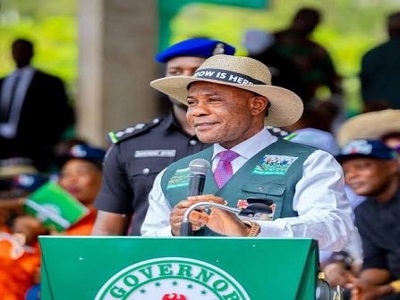
Mbah Administration Deepens Investment in Agriculture, Jobs and Human Capital as Enugu Targets Commercial Livestock Production.
Enugu Media Village (EMV), the Most Updated Online News Platform | September 22, 2026.
The Enugu State Government has engaged more than 160 veterinary and paraveterinary doctors, laboratory scientists and other professionals as part of a renewed drive to revive livestock production and strengthen the agricultural value chain across the state.
The recruitment, disclosed by the Commissioner for Agriculture, Dr. Patrick Nwabueze, during a familiarisation meeting with the newly engaged workers, is part of the administration of Governor Peter Ndubuisi Mbah’s broader effort to reposition agriculture as a productive and commercially viable sector of the Enugu economy.

According to the Commissioner, the recruitment is intended to address the shortage of professional manpower that has affected veterinary and technical services in the state over the years.
He disclosed that Enugu has 17 veterinary clinics across its 17 local government areas, with the government now determined to revive the facilities and improve the quality and reach of services available to livestock farmers.
“We have 17 veterinary clinics across the local governments in the state, and we want to revive all of them,” Nwabueze said, explaining that the recruitment process was deliberately structured to attract qualified professionals capable of providing the expertise required to transform the sector.
From Subsistence to Commercial Livestock Production
The significance of the intervention extends beyond the employment of professionals. It represents an effort to strengthen the institutional and technical foundation required for a modern livestock economy.
The State Project Coordinator of the Livestock Productivity and Resilience Support Project (L-PRES), Dr. Ifeyinwa Nnajieze, said three of the newly engaged workers would be posted to each of the 17 local government areas to provide livestock-related services.
She described the initiative as evidence of the administration’s intention to move livestock production from predominantly subsistence activity towards commercialisation.
With professional personnel available closer to farmers, veterinary services can potentially improve in areas such as animal health, disease prevention, laboratory support, livestock management and productivity.
The state government also said technology and innovation would be deployed to improve productivity and strengthen the livestock value chain.
A Wider Strategy for Agriculture and Economic Diversification
The veterinary recruitment also fits into a wider development strategy under the Mbah administration, which has placed economic expansion, infrastructure, human-capital development and sectoral reforms at the centre of its development agenda.
Governor Mbah has repeatedly described his administration’s approach as one focused on building the systems and productive capacity required for a different economic future for Enugu. At the third anniversary of his administration, he said the transformation agenda involved rebuilding the state’s economic, cultural and institutional systems rather than simply delivering individual projects.
Agriculture is an important component of that broader economic strategy because its impact extends beyond farming itself. A stronger livestock sector can create opportunities across breeding, animal health, feed production, processing, transportation, marketing, retail and other related businesses.
The recruitment of more than 160 professionals therefore provides both a public-service and economic-development dimension: it expands employment while simultaneously supplying specialised manpower for a productive sector.
Human Capital as Infrastructure for Development
One of the notable features of the intervention is its emphasis on people.
Roads, schools, healthcare facilities and other physical infrastructure require skilled personnel to deliver their intended benefits. The same principle applies to agriculture: modern farms and livestock investments require veterinarians, laboratory scientists, technicians and other professionals.
This makes the recruitment an investment not only in the livestock sector but also in the human-capital base required to sustain agricultural development.
The administration has similarly pursued manpower development in other areas of government. In February 2026, the state government announced plans to upgrade the Staff Development Centre into a Public Service Training Institute as part of efforts to strengthen the capacity of the state workforce.
Connecting Agriculture to Enugu’s Economic Future
The livestock intervention comes at a time when the Mbah administration is pursuing a broader economic transformation agenda.
The state’s 2026 budget, presented as a framework for consolidating and accelerating economic growth, proposed a total budget of approximately ₦1.617 trillion, with about 80 per cent allocated to capital expenditure and the economic sector receiving the largest sectoral allocation.
The administration has also reported major interventions across roads, education, healthcare, aviation, urban development and other sectors. In September, the state government unveiled a compendium documenting more than 10,000 milestones, including over 1,521 kilometres of roads, more than 7,000 classrooms and 260 Type-2 Primary Healthcare Centres.
Against this backdrop, the livestock recruitment adds another dimension to the administration’s development programme: strengthening the productive economy through specialised manpower.
The Bigger Picture
For Enugu’s livestock farmers, the immediate expectation is improved access to professional veterinary and technical services.
For government, the longer-term objective is broader — creating the human and institutional capacity required to turn livestock from a largely subsistence activity into a stronger commercial value chain.
For young professionals, the recruitment also represents employment opportunities in a sector where specialised expertise is essential.
Ultimately, the success of the initiative will depend on effective deployment of the personnel, restoration and equipping of veterinary clinics, sustained funding, adoption of technology, support for farmers and the development of markets capable of absorbing increased livestock production.
The recruitment of more than 160 professionals is therefore an important step, but its lasting impact will be measured by how effectively the new workforce contributes to healthier livestock, higher productivity, stronger farmer incomes, new businesses and a more commercially organised agricultural sector.
For the Mbah administration, the livestock intervention illustrates a broader development approach in which infrastructure, human capital, agriculture, technology, employment and economic diversification are treated as interconnected components of Enugu’s development journey.
Enugu Media Village (EMV), the Most Updated Online News Platform — Informing Enugu, Connecting the World; Promoting Accountability, Public Participation, Transparency and Good Governance.